

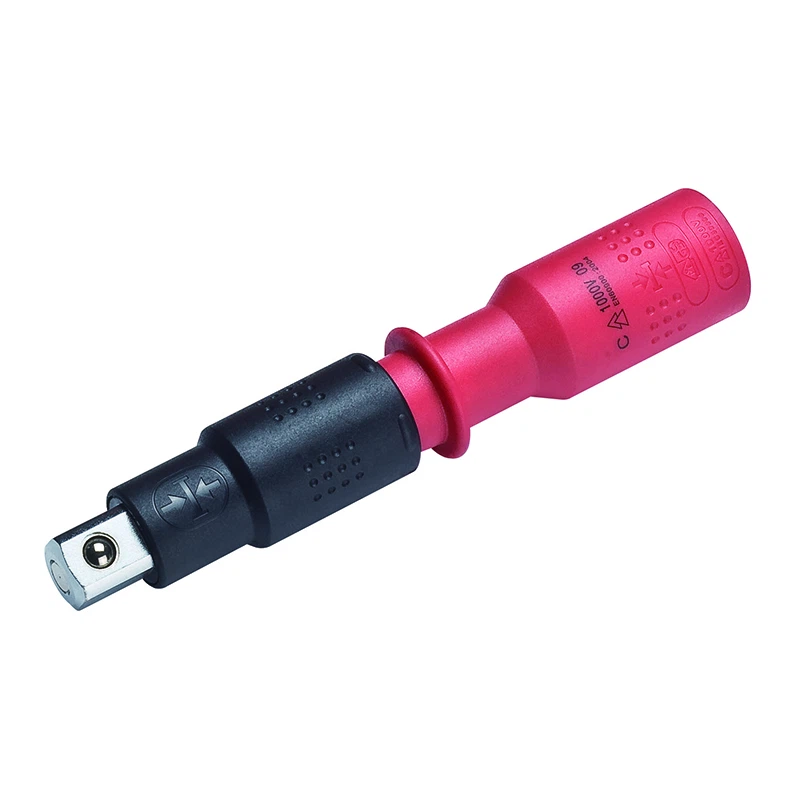
As a supplier of VDE Insulated Extensions, I've witnessed firsthand the diverse environments in which these tools operate. Extreme temperatures can pose significant challenges to the performance and longevity of tools, and VDE Insulated Extensions are no exception. In this blog, I'll delve into how these extensions perform in extreme cold and hot conditions, backed by scientific understanding and real - world experience.
Performance in Extreme Cold
Material Properties at Low Temperatures
VDE Insulated Extensions are typically made of high - quality metals for the core and specialized insulating materials on the outside. In extreme cold, metals tend to become more brittle. The coefficient of thermal expansion of metals decreases, and they contract. For example, steel, a common material for the core of these extensions, has a reduced ductility at low temperatures. This means that it is more likely to crack under stress.
The insulating materials also face challenges. Most insulating polymers become stiffer in the cold. Their molecular mobility decreases, which can lead to a loss of flexibility. If the insulation becomes too stiff, it may develop small cracks, which can compromise the electrical insulation properties of the tool.
Impact on Functionality
The brittleness of the metal core can affect the torque - transmitting capabilities of the VDE Insulated Extensions. When applying torque, there is a higher risk of the extension breaking, especially if the load is sudden or uneven. The stiff insulation can also make it difficult to connect and disconnect the extension from other tools, such as VDE Insulated Ratchets.
However, modern VDE Insulated Extensions are designed to mitigate these issues. High - performance alloys are used for the core, which have better cold - resistance properties. The insulation materials are formulated to maintain a certain level of flexibility even at low temperatures. For instance, some manufacturers use elastomeric additives in the insulation to improve its cold - weather performance.
Performance in Extreme Heat
Material Degradation at High Temperatures
In extreme heat, the metal core of the VDE Insulated Extensions can undergo thermal expansion. This can cause dimensional changes, which may affect the fit between the extension and other tools. For example, if the extension expands too much, it may not fit properly into a VDE Insulated Torque Wrench.
The insulating materials are also highly susceptible to heat. Most polymers start to degrade at high temperatures. They can lose their mechanical strength, become soft, and even melt in extreme cases. This degradation can lead to a loss of electrical insulation, which is a serious safety concern when working with electrical systems.
Impact on Functionality
The dimensional changes in the metal core can lead to inaccurate torque transmission. The extension may not be able to transfer the required torque efficiently, which can affect the quality of the work. The degradation of the insulation can expose the user to electrical hazards.
To address these problems, our VDE Insulated Extensions are designed with heat - resistant materials. The metal cores are made of alloys that have a low coefficient of thermal expansion, minimizing the dimensional changes. The insulation materials are selected for their high - temperature resistance. Some insulation materials are treated with flame - retardant additives to prevent melting and combustion.
Testing and Certification
To ensure the performance of VDE Insulated Extensions in extreme temperatures, rigorous testing is carried out. These tools are tested in environmental chambers where the temperature can be precisely controlled. They are subjected to cycles of extreme cold and heat to simulate real - world conditions.
VDE (Verband der Elektrotechnik) certification is a well - recognized standard in the industry. It ensures that the tools meet strict safety and performance requirements. Our VDE Insulated Extensions are tested to meet or exceed these standards. The certification process includes electrical insulation tests, mechanical strength tests, and tests for performance under different temperature conditions.
Real - World Applications
In real - world scenarios, VDE Insulated Extensions are used in a variety of industries where extreme temperatures are common. For example, in the oil and gas industry, workers may need to use these tools in Arctic regions where temperatures can drop to extremely low levels. In the automotive industry, engine compartments can reach very high temperatures during operation.
In these industries, the reliability of VDE Insulated Extensions is crucial. A failure due to temperature - related issues can not only lead to downtime but also pose serious safety risks. Our customers have reported that our VDE Insulated Extensions have performed well in these challenging environments, thanks to their robust design and high - quality materials.
Maintaining Performance in Extreme Temperatures
To maintain the performance of VDE Insulated Extensions in extreme temperatures, proper storage and handling are essential. In cold environments, the tools should be stored in a warm place before use to allow them to reach a more suitable temperature. In hot environments, they should be protected from direct sunlight and excessive heat sources.
Regular inspection of the tools is also important. Check for any signs of damage, such as cracks in the insulation or deformation of the metal core. If any damage is detected, the tool should be replaced immediately.
Conclusion
VDE Insulated Extensions are designed to withstand the challenges of extreme temperatures. While both extreme cold and heat can pose risks to the performance and safety of these tools, modern design and manufacturing techniques have significantly improved their resilience. Through the use of high - quality materials, rigorous testing, and proper maintenance, these tools can provide reliable performance in a wide range of temperature conditions.

If you are in need of high - quality VDE Insulated Extensions for your operations in extreme temperatures, please reach out to us. We are committed to providing you with the best tools that meet your specific requirements. Our team of experts is ready to assist you in choosing the right products and answering any questions you may have.
References
- International Electrotechnical Commission (IEC) standards on electrical tools and insulation.
- VDE guidelines and certification documents for insulated tools.
- Technical literature from leading manufacturers of VDE Insulated Extensions.